1 The Real Cause of Most Snoring
Snoring happens when airflow through the mouth or nose is partially obstructed during sleep. As air forces its way through a narrowed passage, the surrounding soft tissues — the soft palate, uvula, and base of the tongue — vibrate. That vibration is the sound you hear.
What determines how narrow that passage is? Largely, gravity. When you sleep on your back, your tongue and soft palate drop backward under gravity's pull. If your head is also tilted at the wrong angle due to a poor pillow, the effect is amplified. The airway narrows further, the tissues are more likely to vibrate, and the snoring gets louder. Choosing the best pillow for snoring starts with understanding this mechanism.
This is why the majority of snoring is classified as positional snoring — snoring that significantly worsens or only occurs in specific sleep positions. According to the Sleep Foundation, positional snoring is among the most responsive sleep issues to non-medical intervention. And positional snoring is highly responsive to changes in sleep posture.
2 How a Pillow Affects Your Airway
Your pillow controls two things that directly impact airway patency: head angle and neck position. Both matter significantly for snoring.
Head Elevation
One of the most effective features in the best pillow for snoring is proper head elevation. Sleeping with your head slightly elevated — roughly 4 inches above the mattress for most adults — uses gravity as a mild counter-force against airway collapse. The elevation keeps the base of the tongue forward, preventing it from falling back and obstructing the airway. This is why even a wedge pillow under a standard pillow can reduce snoring for some people.
Neck Angle and Chin Position
If your pillow is too flat, your neck extends backward. This pulls the throat structures taut in a way that can paradoxically narrow the airway. If your pillow is too high, your chin drops toward your chest — compressing the front of the throat directly. The ideal position is a neutral neck with a slight chin-forward tilt, keeping the trachea open.
A contoured memory foam pillow with the right loft for your body size naturally positions the head and neck in this optimal alignment without you having to think about it — which is exactly what separates the best pillow for snoring from a standard foam block.
Sleep Position Maintenance
One underrated function of a good pillow is keeping you in position. A flat, soft pillow offers no resistance — you'll roll onto your back without noticing. A contoured pillow with a defined shape gently encourages you to maintain side sleeping throughout the night, which is consistently the most effective positional intervention for reducing snoring. This is why shape retention is a non-negotiable feature in any best pillow for snoring.
Cervical alignment during sleep directly determines whether your airway stays open or collapses under gravity.
3 What Won't Work (And Why)
Not all snoring interventions are equal, and it's worth understanding where the best pillow for snoring fits in the broader spectrum of solutions — and where it doesn't.
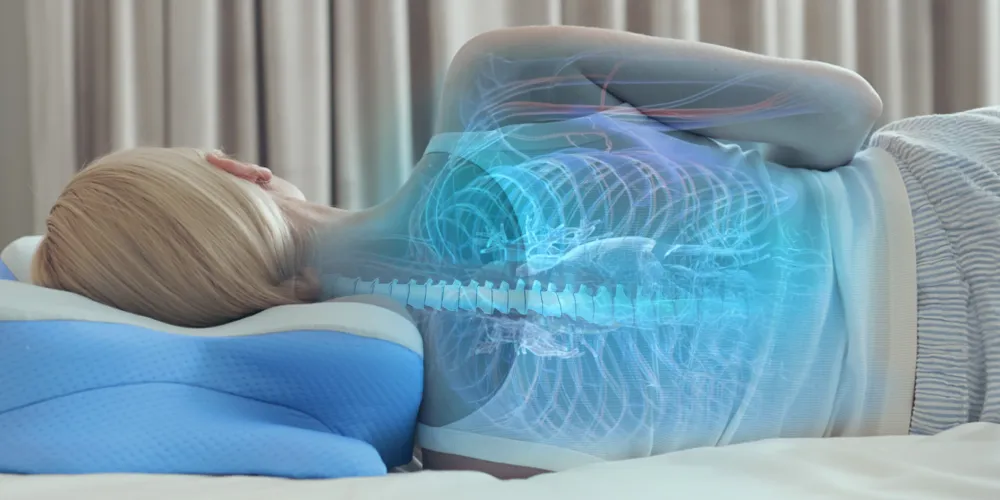
Poor head positioning compresses cervical vertebrae and brachial plexus nerves — a pillow that maintains alignment eliminates this at the root.
- Soft, low-profile pillows: These provide no postural support and allow the head to sink into a position that worsens airway collapse. If you're currently on a flat foam or down pillow, it may be contributing to your snoring.
- "Anti-snore" pillows with vibration sensors: These work by alerting you when you snore — but they fragment your sleep without addressing the underlying cause. Most users stop using them within weeks.
- Pillows alone for sleep apnea: A pillow is not a treatment for obstructive sleep apnea. If you suspect you may have OSA (waking frequently, gasping, excessive daytime sleepiness), see a doctor. A CPAP device is the first-line treatment for moderate to severe OSA.
- Extremely elevated pillows: Propping your head up very high with multiple pillows often compresses the chin toward the chest, which can make airway restriction worse, not better.
4 What to Look For in the Best Pillow for Snoring
When snoring (rather than neck pain alone) is the primary concern, a few specific features become especially important in the best pillow for snoring:
- Contoured shape with defined lateral support: Raised edges encourage and support side sleeping, which is the most effective sleeping position for reducing positional snoring.
- Medium-high loft: Enough elevation to keep the tongue base forward and prevent posterior airway collapse, without over-flexing the neck. Roughly 4 inches is a good starting point for average-build adults.
- Shape retention overnight: This is the most overlooked spec when evaluating the best pillow for snoring. A pillow that compresses flat during the night loses its postural benefits by 2am. High-density memory foam maintains its form through a full night's sleep.
- Breathability: Nasal congestion from heat or allergens worsens snoring by increasing oral breathing. A breathable, hypoallergenic cover addresses this indirectly.
5 Snoring vs. Sleep Apnea — Know the Difference
Before choosing the best pillow for snoring, it helps to understand whether you're dealing with simple snoring or something more serious. Snoring and sleep apnea are related but distinct conditions. Simple snoring (primary snoring) involves noise from airway vibration but without breathing pauses or oxygen drops. Sleep apnea involves repeated complete or partial obstructions that cause the body to partially wake up, sometimes hundreds of times per night.
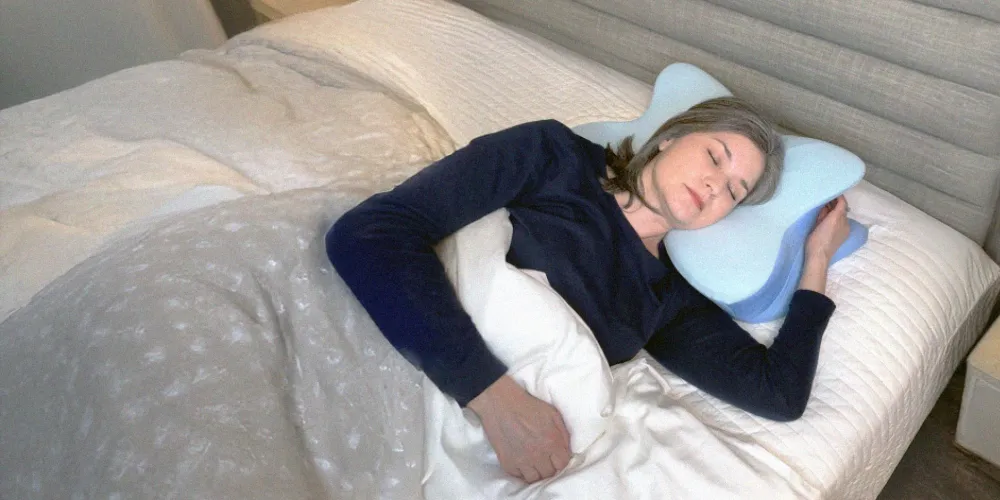
Proper spinal alignment during sleep keeps the airway open and reduces soft tissue vibration — the root cause of snoring.
- Primary snoring: Noise only. No breathing pauses. Partner is annoyed; you feel reasonably rested. The best pillow for snoring is an appropriate and low-risk first intervention.
- Obstructive sleep apnea (OSA): Breathing pauses (apneas), gasping or choking sounds, restless sleep, waking with headaches, significant daytime sleepiness. Requires medical evaluation and typically a sleep study.
- Upper airway resistance syndrome (UARS): A middle ground — no full apneas, but enough airway resistance to cause repeated micro-arousals. Often misdiagnosed as insomnia. Positional therapy can help but isn't sufficient alone.
- Mouth breathing during sleep: Often co-occurs with snoring. A pillow that supports the jaw forward (keeping nasal passages more accessible) can reduce mouth-open sleeping for some people.
If you're uncertain which applies to you, the simplest starting point is asking your partner (or recording yourself) to observe whether you have breathing pauses. A smartwatch with sleep tracking can also provide initial data worth discussing with a doctor.
For more on the overlap between pillows and sleep apnea, see our dedicated guide: Sleep Apnea & Pillow Choice →. If neck pain is also a concern alongside snoring, see our best pillow for neck pain guide and our deep-dive on best ergonomic pillows for neck pain.
6 Frequently Asked Questions
Can a pillow actually stop snoring?
For positional snoring — the most common type — yes. A pillow that maintains proper head and neck alignment keeps the airway open, preventing the soft tissue collapse that causes snoring. It won't address snoring caused by anatomical issues like a deviated septum, but it's a meaningful first step for most people.
What sleeping position is worst for snoring?
Back sleeping is the worst position for snoring. Gravity pulls the tongue and soft palate backward, narrowing or partially blocking the airway. Side sleeping with the right pillow is the most effective positional intervention for reducing snoring.
How high should a pillow be to reduce snoring?
A pillow that elevates the head about 4 inches combined with side sleeping is most effective for most adults. The goal is keeping the chin slightly forward and the airway open — not so high that the neck bends forward, which can restrict airflow from the other direction.
My partner snores but I can't make them change positions. What can I do?
Replacing their pillow with a contoured memory foam option is the least disruptive intervention — they won't notice the difference in their routine, but the pillow will gently encourage better positioning. Beyond that, white noise machines or earplugs can help the non-snoring partner sleep through it while other solutions are tried.
Is memory foam the best pillow for snoring?
For positional snoring, yes — high-density memory foam maintains its loft and shape throughout the night, which is essential. A regular down or polyester-fill pillow compresses flat within hours, losing its postural support. Memory foam also contours to the neck's natural curve, which keeps the airway in a more optimal position. Look for a contoured (butterfly) shape rather than a flat slab, as the raised edges encourage and support side sleeping.
How long does it take to see results from changing your pillow?
Many people notice a difference within the first 1–2 weeks, once they've adjusted to the new pillow. It takes a few nights for your body to adapt to the new neck position, especially if you've been sleeping on a flat pillow for years. Give any new pillow at least 2 weeks before drawing conclusions. If snoring persists significantly after 4 weeks, the cause may be beyond positional — worth seeing a doctor at that point.
Can a pillow help with snoring if I sleep on my stomach?
Stomach sleeping is complicated for snoring. On the positive side, it does prevent the tongue from collapsing backward (which is the main mechanism for back-sleeping snoring). However, it severely rotates the neck to one side, which strains cervical vertebrae and can create its own airway compression issues. If you're a stomach sleeper, the best pillow approach is actually to use a very thin pillow (or no pillow) to keep the neck as neutral as possible, while transitioning toward side sleeping long-term.
Tired of the nightly noise?
The Derila Ergo is our top-rated best pillow for snoring — designed for better airway alignment and quieter nights.